NO FILES. NO OBLIGATION.Step 1 of 3 · Your business

What does your company do?

Start with your business. We’ll ask for your email at the end.

YOUR INFORMATION

You choose what you share

Before any data sale

We agree what records may be included and how they may be used. Information you are not entitled to share must stay out. Removing names does not cancel confidentiality agreements or make every record safe to sell.

When you ask for an assessment

NextLevel Data Broker uses your company name, email and the business details you enter to review your enquiry and contact you about an assessment. Requests are stored securely on our server. They are not published on the website, and submitting does not sign you up for marketing.

Do not enter customer identities, bank details, passwords or confidential business information. This form does not ask you to upload files.

Website tools

This website uses no advertising trackers or marketing cookies. Fonts are served from our own server. The animation can be paused and respects your reduced-motion setting.

When the team contacts you, you can ask about your enquiry, corrections or deletion by replying to them. Continuing use of records already sold is governed by the separate data agreement. Full website privacy notice

EXTRA INCOME FROM EVERYDAY BUSINESS


for company data
you can legally share
and already own

Your orders, calls and job records show how real businesses work. AI companies want to learn from that. We help you sell the parts you can share.

No files to upload. No commitment to sell.

No confidential or sensitive information.
You approve what is shared.
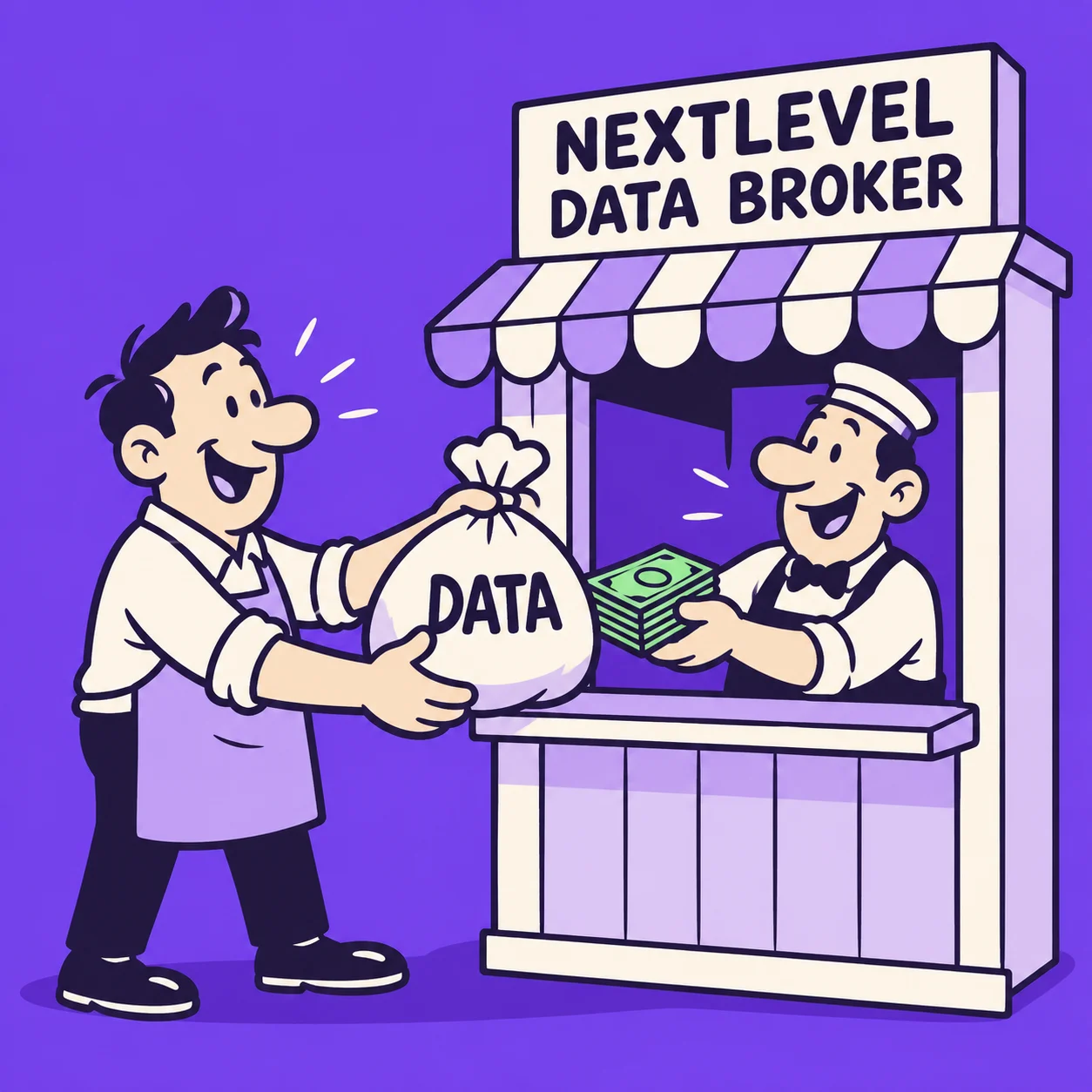
THE IDEA, IN A FEW SECONDS
A business owner exchanges a bag marked DATA for cash at the NextLevel Data Broker shop window.
01 / 03

Your work creates useful records

Orders. Deliveries. Problems solved.

Sale of your existing records: usually $50k–$500k. Then $25k–$250k a year from new records, and growing.Preliminary valuation within one week.

We help you earn from data you already own

  • Growing
  • Steady
  • Closing or closed

Examples

Example: a software company’s product history

An idea. A product customers rely on

Design

Team agreed what to build and why.

Build

Features written, reviewed and tested.

Launch

Released to customers, feedback tracked.

Support

Customer problems fixed and recorded.

Real experience
A useful lesson for AI

This follows a real product from first design to everyday support. It can help AI learn how software teams plan, build, test and keep improving a product.

We check what you own and are allowed to share. Private details and restricted information stay out.

YOU DON’T HAVE TO FIGURE IT OUT ALONE

Tell us about your business
We help you prepare the data you can legally share — and get you paid for it

1

Start without sending files

Tell us what you do and what records you keep.

2

See what can be included

We check the opportunity and what must stay private.

3

Choose whether to sell

Review the offer and payment terms. Your agreement is with us.

Your records. Your choice. You approve the package before it is shared.

BEFORE YOU DECIDE

The questions owners ask

No technical background needed.

Who uses my data, and what for?

AI companies use the records you agree to share to train AI. Learning how real businesses work can help applications like ChatGPT become smarter and more useful.

What data can I get paid for?

Useful business records can include:

  • Emails and documents — business conversations, instructions and reports.
  • Phone calls — approved recordings or written versions of conversations.
  • Sales and deliveries — quotes, orders, stock records and delivery reports.
  • Finance records — invoices, budgets and how accounts were checked.
  • Staff and training materials — hiring steps, training guides and job instructions.
  • Work saved in business software — customer records in a CRM, designs in Figma or Adobe, and project notes in Jira or Confluence.

We check what buyers want and what you can share. Confidential, sensitive and restricted information stays out.

What about confidential information and customer agreements?

You do not share information you are not allowed to share. We help separate what could be sold from what must stay private. Agreements with customers still apply, even if names are removed. You approve what is included.

How much could I earn, and when do I get paid?

As a rough guide, a first sale of existing records is usually worth $50k–$500k. If you keep selling new records, that can add $25k–$250k a year, and more if you improve how records are kept or add useful tools. The real amount depends on what you have and what buyers will pay. The quickest way to know is a preliminary valuation, which we aim to give you within one week.

We explain our offer and when you would be paid before you agree. If payment depends on us selling the records on, we tell you first. An estimate is not a guaranteed payout, and yearly payments apply only if your contract says so.

How big does a company need to be for its records to be worth money?

Records often start to be worth money from about 20–30 people. But size matters less than how your work is recorded: how much of it is written down, in how many tools, and how much of it you are allowed to share.

Today’s headcount is not the whole story either. If you have fewer people now but employed more in earlier years, those years of records still count. If you are unsure, ask for an assessment and we will tell you honestly.

How much work is involved? Are there any costs?

We handle the preparation and sales work. Your team helps us check the records and approve what can be shared. Any charges or deductions are explained before you sign. For Data Farming, we can provide extra software at no charge, if helpful.

Can this become a yearly source of income?

If your business is still running, new records could lead to new sales each year. We help you keep more useful information as you operate as usual. We call this Data Farming. Yearly payments are only guaranteed if your contract says so.

LET’S FIND OUT WHAT YOU HAVE

Your next sale could come
from work you’ve already done

Start with a short company assessment.

No files to upload. No commitment to sell.
Find value in
what you already have.